Owner-reported updates introduce inconsistency and subjective interpretation
Limited real-world visibility increases training failures and dog wash-outs.
Lack of ongoing signals prevents timely intervention and course correction
Wash-off Risk
Recall Bias
Data Continuity
"I'm finding it harder and harder to keep track of everything I need to keep track of"
"Once the dog leaves the facility, I lose visibility. I rely on owner recall, which makes it difficult to adjust training accurately"
Owner
Trainer
“I was in a situation where I cannot get a dog that fails training because I do not have enough money… I just can’t do that.”
Owner
Conceptualization
Through visualization of the service dog training process, we identified areas for improvement in efficiency and highlighted challenges faced by stakeholders. Specifically, we pinpointed two key pain points:



During community research with service dog trainers and owners, we found that fewer than 1% of Americans who could benefit from a service dog are able to access one due to high training costs.
Trainers reported that nearly 60% of dogs are washed out during training, often after significant time and financial investment. Through interviews and observation, we identified that limited trainer availability, repeated training steps, and poor visibility into training data contribute directly to these outcomes.
Interviewing Stakeholders
Concept Co-Development
Concept selection
Concept Prototyping
Evaluative research
Prototype Refinement
Solution implementation
User flows & Prototyping
Week 8 - 13
Narrative Development
Narrative refinement
Partner Pitch & Feedback
Partner pitch &
Feedback
Week 14 - 15
Tasks
Duration
Phase
Week 1 - 2
Opportunity Framing
Insight Generation
Generative Research
Ideation
Idea Development
Idea Selection
Intent Coversation
Brief Exploration
Partner management
Team Building
Project Planning
Problem Definiton
Discovery & Scoping
Service Dog Exploration
& Ideation
Week 3 - 7
Design Process
The Solution
Create an AI-assisted training, wearable and companion app, that detects and interprets the owner’s condition, translating multiple situations into a single trigger. By tracking training data over time, the system helps reduce wash-off rates.
Laika is an AI-enabled service design project that helps service dog owners and trainers simplify the complexity of daily training routines. By pairing a wearable (watch + dog collar) with a mobile app, Laika provided real-time guidance, session logging, and dashboards to support consistent, accessible training.
Cross-device native mobile experience
Role
Product Designer
End-to-end design from research, design, to delivery
Stakeholder interviews, IA, wireframes, prototypes, and user testing
Team
Manager (Angel)
Researcher (Anupama)
Designer (Me)
Designer (Tania)
Tools
Figma
Adobe After Effects
Miro
Notion
Company
Microsoft
Parsons
5 Months
Duration
The Problem
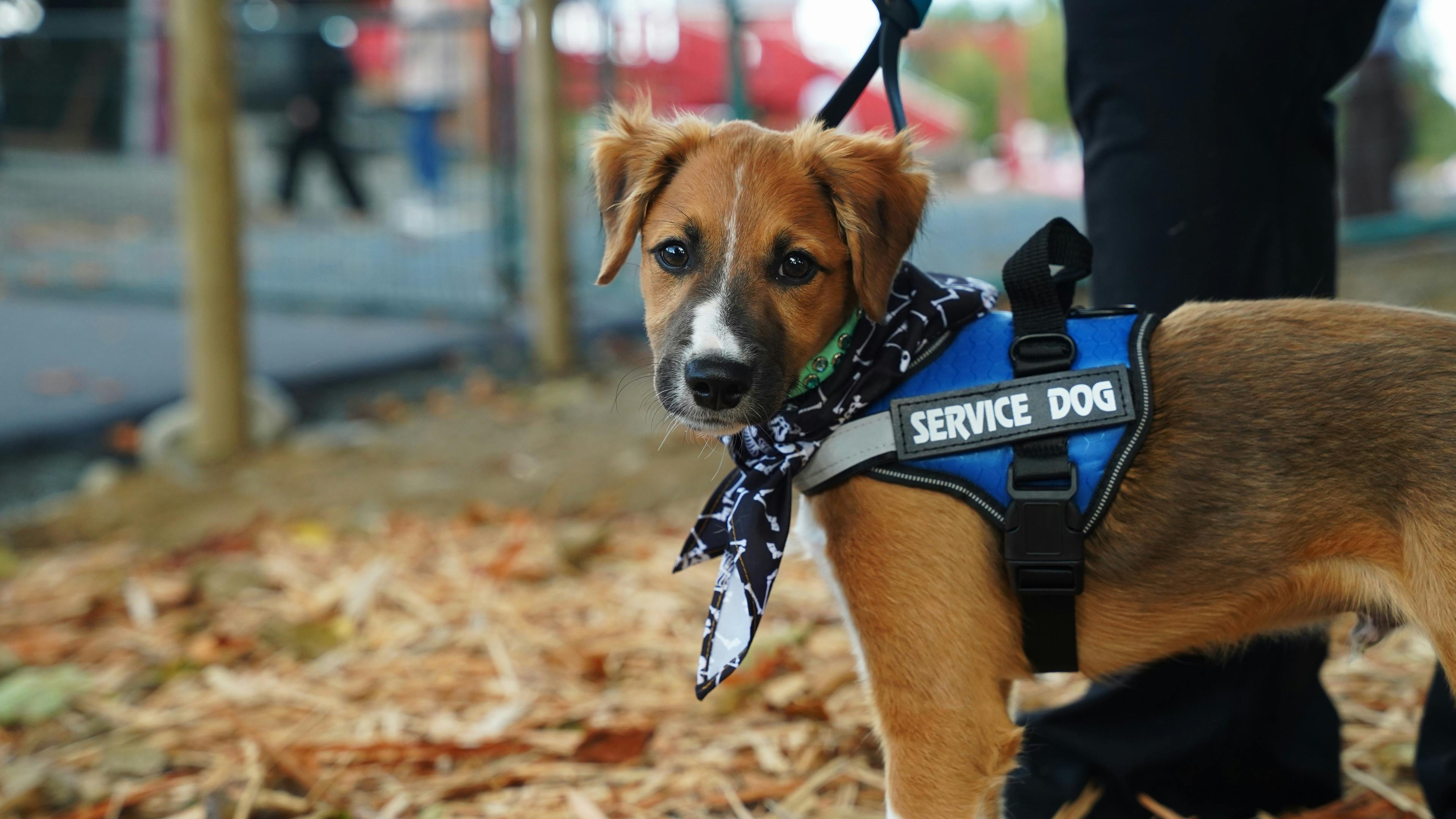

Service dog training is constrained by limited trainer availability, dogs are required to learn multiple cues for similar actions, and owners struggle to track and interpret training data.


Designing for Native iOS
Service dog owners use their phone one-handed, in public, while managing a dog in distress. That constraint shaped every native iOS decision. Working within Microsoft's product ecosystem, SF Pro typography, bottom tab bar, 44pt touch targets, and safe area insets throughout.
Designing for
distributed AI
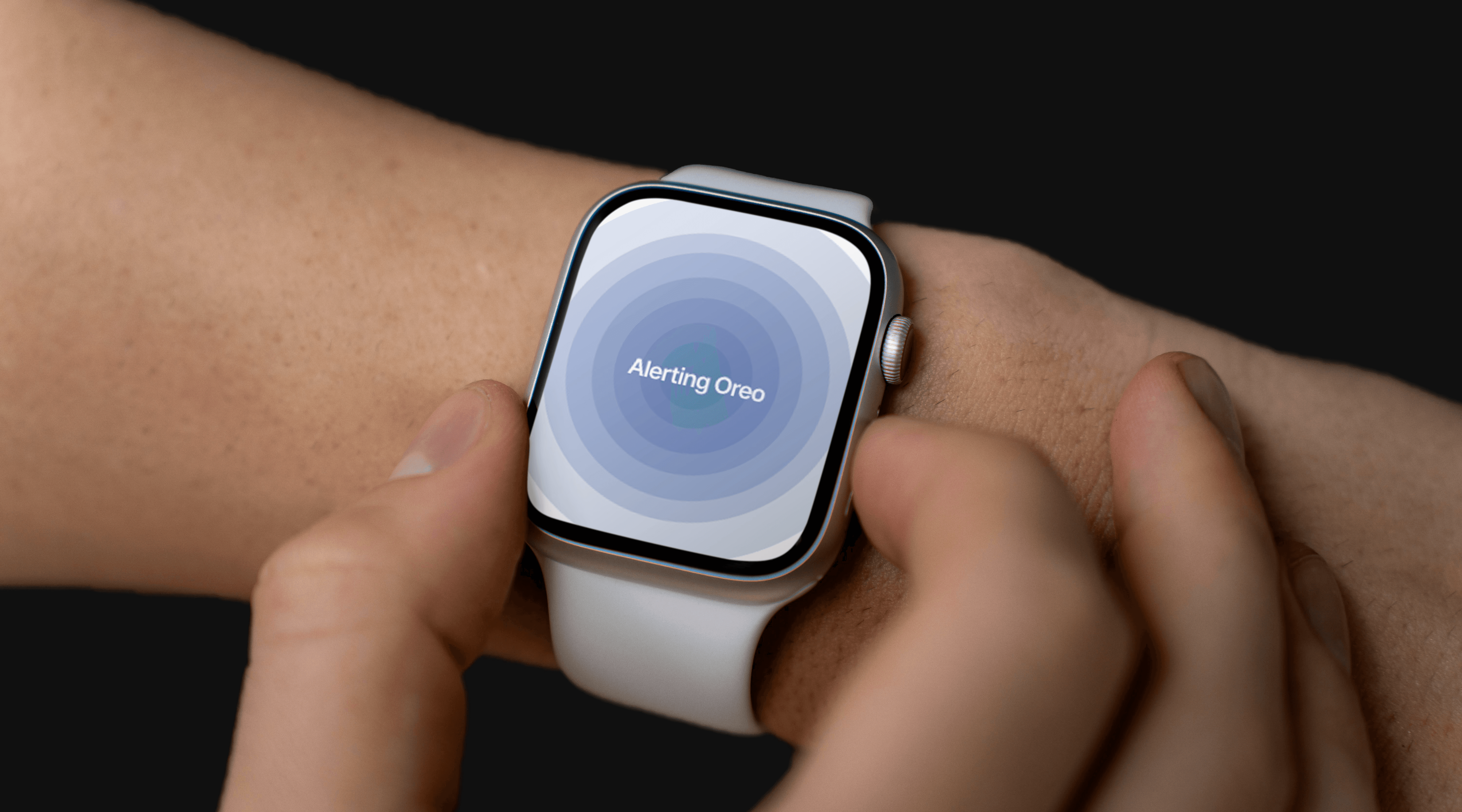
Laika was designed as a three-device ecosystem integrated with Microsoft Azure AI and IoT services. Each device has a distinct role: the dog wearable passively detects behavioral signals, the Apple Watch delivers real-time prompts during critical moments, and the mobile app provides long-term insights and training history.
Passive sensing of physiological and behavioral signals
Dog Wearable
Real-time prompts and confirmations during critical moments
Watch
Long-term insights, trends, and training progress
Mobile App
Start, Stop & Continue
Start
Clarifying team roles and strengths early to align expectations and ensure balanced collaboration
Practicing tool agility—switching methods or platforms when current ones limit progress
Stop
Over-indexing on iteration without converging, focus on narrowing down solution portfolios
Limiting research to direct users broaden lens to include analogous and edge-case users
Continue
Involving stakeholders early as co-creators, not just interviewees
Testing with low-fidelity prototypes pre-MVP and crafting clear user communication around it
Key Screens &
Design Decisions
The following screens show the two primary flows: the Reports flow, where owners track and share training progress, and the Copilot flow, where owners get AI-assisted guidance powered by Microsoft Azure.
Each design decision was driven by a single constraint: users are often one-handed, managing a dog in real time. Every interaction had to work with a thumb.
9:41
Good morning, Taylor
Oreo • Last synced 2 min ago
RESPONSE ACCURACY
72%
3 missed this week
View weekly report →
THIS WEEK
M
10
T
11
W
12
T
13
F
14
S
15
S
16
Medication Alert Response
09:30 AM
09:30 AM
Missed
Public Anxiety Cue
11:00 AM
11:00 AM
Upcoming
Fetch Medication Kit
09:30 AM · Repeats every 4 hours
Remind Later
Mark as Taken
Priority actions surface above the fold — critical for one-handed use while managing a dog
Copilot as primary action — replaces FAB.
Inline data visualization
9:41
Reports
This Week
This Month
All Time
Week of Mar 17 – 23
68%
↓ Down 4% from last week
ACCURACY
68%
↓
MISSED
4
STREAK
3 days
EPISODE LOG
Morning Medication Alert
Mar 20, 09:30 AM
Completed
Public Anxiety Cue
Mar 19, 11:00 AM
Missed
Evening Deep Pressure
Mar 19, 08:00 PM
Upcoming
Share Weekly Report
Scoped filter chips
Primary CTA pinned above safe area — always accessible
Progressive disclosure — summary stat first, detail on tap
9:41
Copilot
Ask anything about Taylor or Oreo
Powered by Microsoft Azure AI
Why is Oreo missing anxiety cues?
What does 72% accuracy mean for us?
How do I prepare for a public outing?
Ask anything...
Context-aware prompts pulled from dog’s live data — eliminates blank slate anxiety
Voice primary, text secondary — users are one-handed with a leash
Microsoft Azure AI — explicit integration callout
9:41
Copilot
My dog keeps missing the anxiety cue when we're in busy public spaces
Anxiety cue misses in public spaces are usually caused by overstimulation. Oreo may need shorter, more controlled exposure sessions before graduating to busy environments.
📊 Based on Oreo's data this week
Response accuracy in public spaces — 43%
Response accuracy at home — 91%
Most missed: Tuesday afternoons
Log a training note
Copilot responses are AI-generated. Always consult your certified trainer.
Ask anything...
Personalized response using Azure IoT data
Responsible AI disclosure
Action inside response to close the loop without exiting.
9:41
Copilot
My dog keeps missing the anxiety cue when we're in busy public spaces
|
Tap to stop
Ask anything...
Pulsing rings — consistent with Apple Watch alert animation
Live transcription to confirm the system is listening
9:41
Copilot
My dog keeps missing the anxiety cue when we're in busy public spaces
Anxiety cue misses in public spaces are usually caused by overstimulation...
What should I do differently at Tuesday sessions?
1
Shorten to 10-minute sessions
2
Introduce one distraction at a time
3
Always end on a successful response
Set reminder
Share with Alex
Copilot responses are AI-generated. Always consult your certified trainer.
Ask anything...
Contextual action chips — act on suggestions without leaving conversation
Session memory — Copilot holds context across the conversation